Essay
Now everyone's doing ontology. Almost nobody's doing the hard part.
The biggest data platforms are racing to put an ontology under their agents. The word has gone mainstream, but the work that makes it real hasn't. A field guide to the two layers, the semantic layer that enforces them, and why Phase 2 decides how far your agents travel.
Not long ago, “ontology” was a conversation killer. Drop it in front of a business or IT crowd and the energy left the room. So you shipped the value and left the word off the slide.
That’s over.
In the space of a few months, the biggest data platforms have all planted a flag. Databricks put out Genie Ontology. Google Cloud has a Knowledge Catalog stitching a semantic graph across the enterprise. Snowflake pulled its competitors into a table around Open Semantic Interchange. Whatever their differences, they agree on one thing: their agents need an ontology underneath them.
I called this months ago. Two predictions: that this would be the year ontology went mainstream, and (the part I liked less) that the big vendors would pull it away from its open roots and hand it back as a feature you rent. Both are landing.
The reason is simple. Generative AI is dazzling and completely untethered. An ontology is the cleanest way to anchor it: a single, consistent layer of meaning the model can actually reason against instead of improvising.
And it’s an old idea, not a new one. Aristotle was formalising concepts and their relations millennia ago. Berners-Lee re-cast the same instinct for the web. Google turned it into schema.org, which now quietly structures a huge share of the pages you read. What’s genuinely new is the terrain: not the public web, but the inside of your own company, with its customers, its workflows, its accumulated mess.
Why it suddenly matters
Fuzzy definitions never used to hurt us. People were the glue.
When you say “active customer,” do you mean someone who bought in the last 3 months? Or 6? Most companies can’t answer cleanly. Ask three teams, you get four definitions. And it never mattered, because we patched the gaps in our heads. Cindy in finance says “order” in a meeting, and everyone silently translates to “B2B order,” because they know Cindy, and they know the context. That translation never got written down. It lived in people.
Agents don’t have that glue. An agent uses exactly what you feed it. Hand it a fuzzy definition and it acts on the fuzziness, with confidence, at speed, at scale. The vagueness we used to absorb quietly becomes wrong answers we ship to customers.
So the question stops being “should we build an ontology” and becomes “how do we build a trustworthy one without burning three years on it.”
The two layers
I’ve been building this in production for over a decade, and it’s deeply pleasing to watch it arrive. But doing it for real teaches you what the launch slides leave out. The devil’s in the detail, and there’s a lot of it.
The way I think about it, an ontology has two layers.
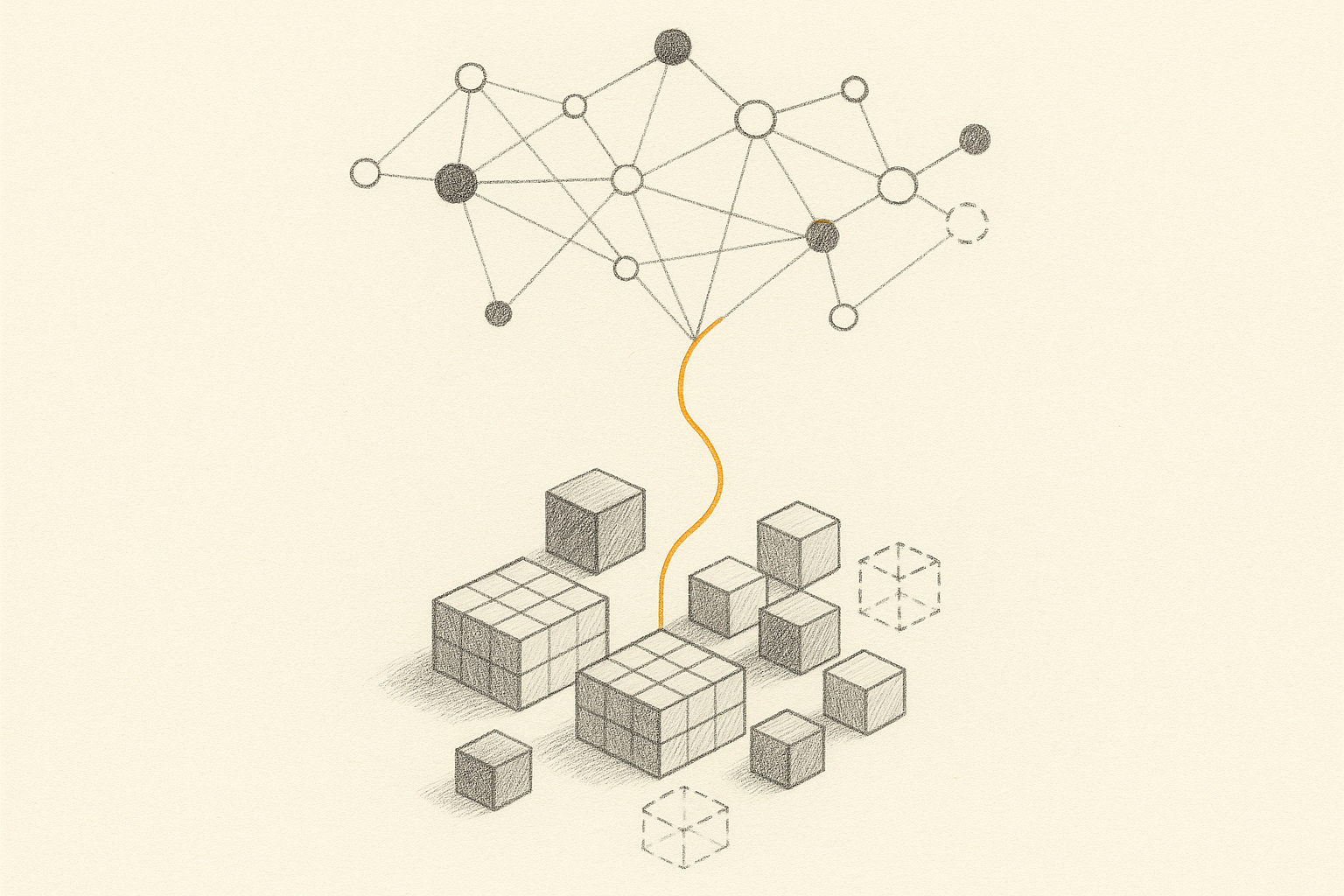
The physical layer is your actual data. Tables, columns, lineage. You can largely infer this (which tables connect, what the metadata implies) and let the machine draft the semantic map for you. This part can be automated now. The gaps it exposes, hubs with no model behind them yet, are the map telling you where the fuzziness lives.
The logical layer is where humans show up. The business glossary. The logical data model. What a “customer” or an “order” actually is. No model invents this for you. It’s a decision, not a discovery. The strongest starting points are the standard ERP and CRM reference models: decades of “what an order is,” already encoded, easy to apply to standard business.
The machine drafts the physical. Humans own the logical. That split is the unlock. It’s also where the nuanced calls live (taxonomy versus ontology, inheritance versus composition), the ones that decide whether the thing holds up in production or quietly rots.
Where the semantic layer fits
The ontology is the agreement. The semantic layer is where that agreement gets enforced.
It sits between your raw data and everyone (and everything) that queries it. A dashboard, an analyst, an agent: they all ask for “active customer” and get the same definition, resolved to the same tables and the same filter. Define once, use everywhere.
Without it, every definition gets re-implemented in every report, every query, every prompt, and drifts a little each time. The semantic layer is how the ontology stops being a document nobody reads and becomes the thing your systems actually run on.
Why this is the foundation, not the finish line
Zoom out. It moves in three phases.
Phase 1: the agent wave. The open web got compressed into the model, and out came systems that could reason and take action.
Phase 2: pulling context together. The rush to build the ontologies and semantic layers those agents stand on. This is the phase we’re living in.
Phase 3: the Agentic Web. Context turns back outward. Agents start crossing boundaries (buyer to seller, bank to regulator), and they only cross where the meaning on the other side is open enough to carry them.
How well you do Phase 2 sets the range your agents get in Phase 3.
We used to keep the ontology quiet. Now the largest companies on earth are building their AI strategy on top of it. But don’t confuse the headline with the work.
Making an ontology solid, useful, and real inside your organisation is hard, unglamorous labour. The map is never finished. It isn’t meant to be, it’s a living thing. What it does, early, is show you where the real work sits. And it was never the technology.
It was getting people to commit to a definition. That part doesn’t get automated away. It just got more urgent.